

By Javier Muriel, founder of Pranayam®
Progress in pranayama is not measured by the most complex technique or the longest breath retention. The classical texts set out observable criteria – which any practitioner can note down and review – to determine whether they are making steady progress.
Patañjali summarises them in a single sūtra (Yoga Sūtra II.50): the breath is regulated according to the location (deśa), the weather (kāla) and the number (saṃkhyā), and becomes long and subtle (dīrgha-sūkṣma). The Haṭha Yoga Pradīpikā and the Gheraṇḍa Saṃhitā go on to elaborate on the practice. These four terms remain, in my view, the best guide for observing a session.
Deśa: the place
Deśa It is the space of breathing, in and out.
- Outwards: the volume of air inhaled (pūraka) or on the out-breath (recaka). A simple test in Kapālabhāti is to see how far the exhalation moves a light feather.
- Inside: the part of the body where you feel your breath. Breathing that is centred on the abdomen and pelvis does not have the same effect as chest breathing, and shifting your focus from one area to another completely changes the experience.
Kāla: time
Kāla It is time to practise, and this depends on three things: the speed of inhalation and exhalation, the volume of air moved, and the duration of the breath hold (kumbhaka) or the entire cycle. The shallower the breathing becomes, the longer each cycle takes.
The Haṭha Yoga Pradīpikā (II.11) recommends practising the breath-retentions four times a day — at dawn, midday, dusk and midnight — until one reaches 80 kumbhakas per session. This is the ideal for a fully committed practitioner, not a guideline for beginners. The text itself warns (II.15) that the breath is mastered little by little, just as one tames a lion, an elephant or a tiger, and that incorrect practice leads to illness (II.16). That is why everything is tailored to each person’s actual ability.
Saṃkhyā: number
Saṃkhyā It refers to the sequence: the number of cycles and the ratio between inhalation, breath-holding and exhalation.
An example: 12 cycles of Nāḍī Śodhana with a ratio of 1:2:2 and an inhalation lasting 10 counts (mātrās). That same pattern must remain consistent from the first cycle to the last. If this isn’t possible, I shorten the times or revert to a simpler ratio until the practice stabilises.
A session may focus on just one of these criteria, combine two, or – as the practice matures – integrate all three at once.
Dīrgha and sūkṣma: long and subtle
The sūtra concludes by describing the result: a long, subtle breath. It is the synthesis of the three previous criteria, and this is evident in the duration and depth of the practice.
Today, this might mean moving from 10-minute sessions to 30, 45 or 60-minute ones. But the progress that matters isn’t measured in a single session, but in consistency over weeks, months and years.
The body’s signals
The Haṭha Yoga Pradīpikā (II.12) describes three stages: at the beginning, sweat appears; in the middle stage, trembling; and in the final stage, stability. In my reading, sweat usually indicates excessive effort; trembling, a state of awareness that is already more perceptive but is not yet sustained; and stability, a practice without effort or strain.
A workbook
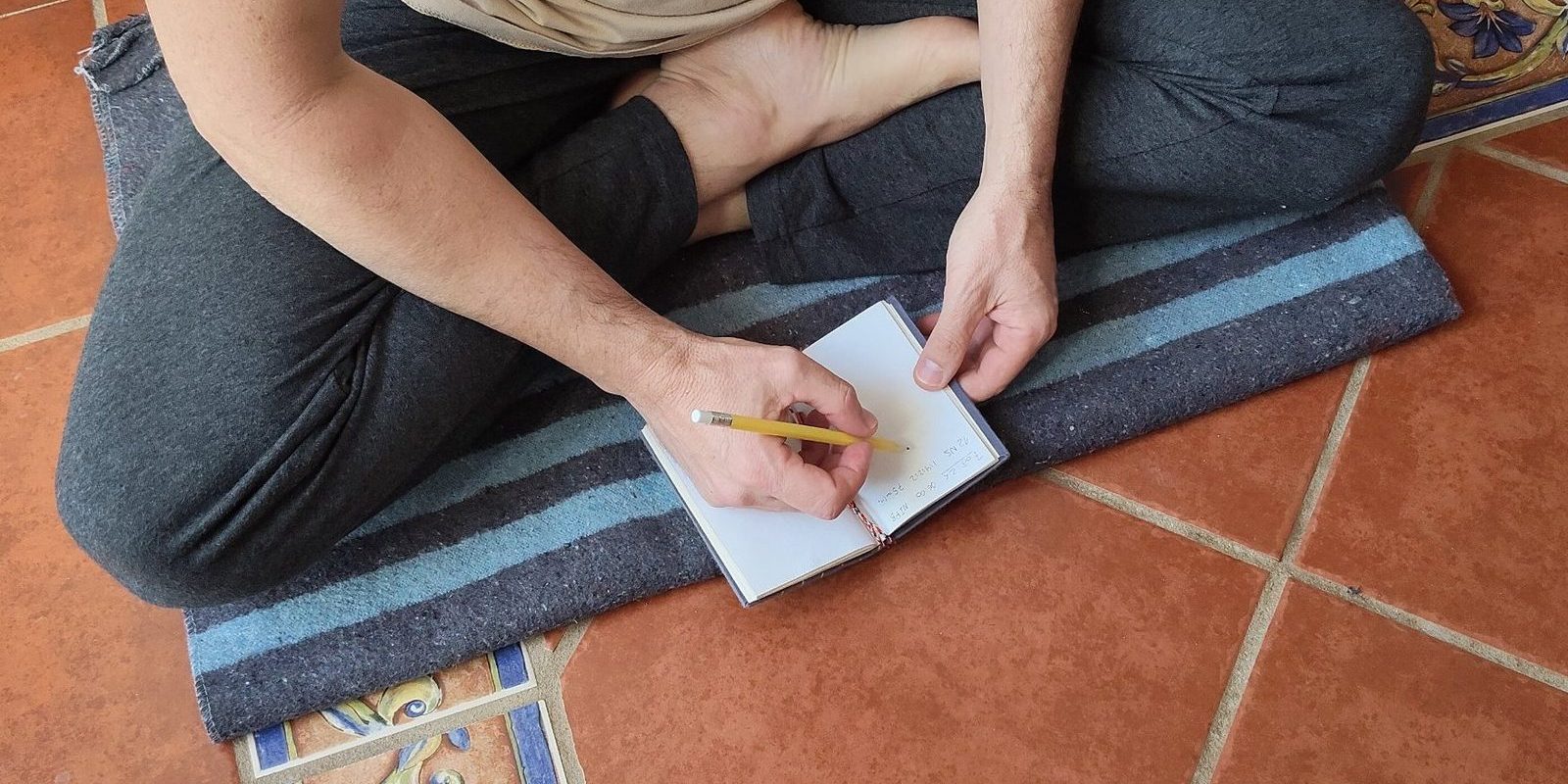
To measure progress against these criteria, I suggest making a note during each session:
- the date and the technique;
- the proportion and number of cycles (saṃkhyā);
- the total duration (kāla);
- where one can feel one’s breathing (deśa);
- the body’s signals: exertion, trembling or steadiness.
After a few weeks, the notebook shows your progress more clearly than any fleeting impression.
To continue
- First steps in pranayama: the base amount, excluding deductions.
- Pranayam® HEY Training, Block 2: the progression of kumbhaka according to these criteria.
Sources
- Patañjali, Yoga Sūtra, Book II (II.50). Translated by Charles Johnston, 1912.
- Svātmārāma, Haṭha Yoga Pradīpikā, Chapter II (II.11, II.12, II.15, II.16). Translated by Pancham Sinh, 1914.
Holistic EcoYoga · A Holística Nature school