PRANAYAM® HEY

Conscious Breathing Method and Integrated Pranayama
A 100-hour training course to understand, practise and teach pranayama using a progressive, somatic and well-grounded approach, integrating yogic tradition, contemporary science, nervous system regulation and a connection with nature.

✔ 100-hour certified vocational training
✔ Online campus with unlimited access
✔ An integrative approach developed since 2013
What is missing from many of today’s pranayama courses?

  • Techniques are taught without an understanding of the respiratory physiology underpinning them
  • Retentions and kumbhakas are introduced without prior work on nervous regulation
  • People talk about prāṇa without a clear understanding of the subtle anatomy
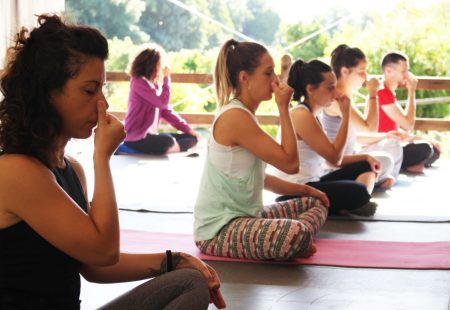
  • And it is practised in a closed room, forgetting that breathing is the most direct form of communication between the body and nature

pranayama-retreat-1024x683

PRANAYAM® METHODOLOGY

A progressive, somatic system developed within the Holistic EcoYoga (HEY) framework

A course that combines classical pranayama with contemporary physiology, nervous system regulation, interoceptive awareness and practising in nature.
  • Yogic tradition: classical pranayama, bandhas, kriyas, kumbhaka, subtle anatomy and Swara Yoga, faithful to the text of the Hatha Yoga Pradipika and the living tradition of Hatha Yoga.

  • Contemporary science: functional respiratory physiology, the autonomic nervous system and polyvagal theory applied to practice.

  • Somatics and interoception: the body as the primary landscape; listening to one’s breath before altering it.

  • Nature and ecology: the five elements as a direct experience; breathing as an integral part of the living environment.

Pranayama Methodology

Structure in 4 sections

BREATHING + TECHNIQUE + SUBTLE ANATOMY + INTEGRATION

Each block comprises 25 hours. The progression moves from the somatic and physiological foundations to the technical mastery of kumbhaka, then on to the experiential understanding of subtle anatomy, and concludes with the integration of the method into daily life and teaching.
BLOCK 1

Fundamentals of the Breathing Body

Block I pranayama_

Before any technique, there is one fundamental principle: understanding how you actually breathe.

It lays the physical, physiological and attentional foundations necessary for a mindful, safe and well-guided practice of pranayama. You will explore the physiology of breathing, the autonomic nervous system and applied polyvagal theory, functional versus dysfunctional breathing, and interoception as a prerequisite for any energy-based practice.

You will learn the essential kriyas (Neti, Tratakam, Kapalabhati) and the introductory pranayamas (Ujjayi, Nadi Shudhi, Bhramari, Sheetali), and you will draw up your own personalised practice plan based on your constitution, breathing pattern and nervous system type.
BLOCK 2

Technique: advanced pranayama and kumbhaka

Block II pranayama_

Breath-holding as a safe, gradual and experiential practice.

An in-depth exploration of the practice of kumbhaka — internal and external breath retention — to understand its physiological, energetic and mental effects, and to integrate it safely into your sadhana. You will practise the bandhas (Mula, Uddiyana, Jalandhara and Maha Bandha), and explore their relationship with the granthis.

You will study classical pranayama techniques: energising (Bhastrika, Surya Bhedana), balancing (Nadi Shodhana, Viloma) and calming/relaxing (Ujjayi, Chandra Bhedana, Bhramari, Sheetali). The weekly progression of kumbhaka, structured over 8 to 16 weeks, offers you clear and safe progress within your tolerance window. You will learn to measure and record your progress using the classical criteria of Desha, Kala, Sankhya and Dirghatva.
BLOCK 3

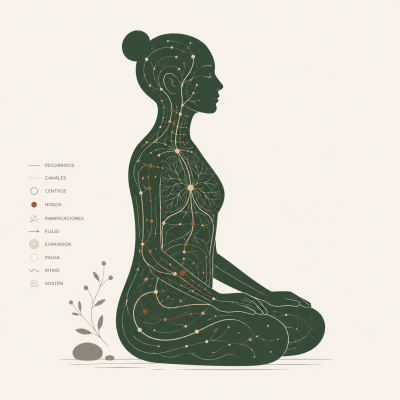
Depth: subtle anatomy and swara yoga

Block III pranayama_

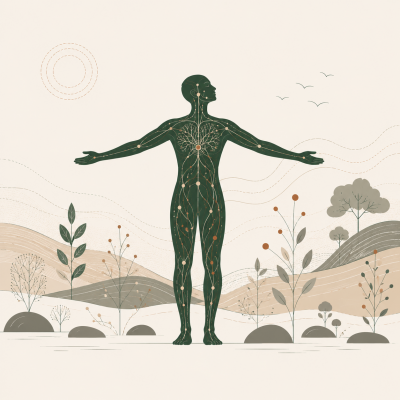
The inner map of prāṇa, experienced from within.

You will learn to recognise the movement of prāṇa and to work with it, using the subtle anatomy as an experiential map rather than merely a conceptual one: the three bodies, the five koshas, the chakras, the main nadis and the pancha vayus. Each element of the map is accompanied by specific practices designed to help you experience it for yourself.

You will study Swara Yoga — identifying the active swara, the tattwas and their everyday application — and connect the subtle anatomy with the autonomic nervous system and with each pranayama practised in the previous modules. Yoga Nidra and Prana Nidra are integrated here as experiential tools for accessing the koshas and the vayus, not as end in themselves.
BLOCK 4

Inclusion: approach, nature and teaching

Block IV pranayama_

From personal practice to conscious transmission.

The final module brings together everything you have learnt into a coherent experience. You will design your own personal sadhana for the following six months and learn how to take your practice out into nature: the five elements as a direct experience, an ecological dinacharya, and breathing integrated into the living environment.

You will work on the principles of responsible teaching, the standardised safety protocol and the first-class guide, so that you can pass on the method judiciously. The session concludes with Prana Nidra for total integration, an experience that unifies technique, nervous system regulation, subtle anatomy and connection with nature.

What you’ll learn on this course

In this course, you will learn how to:
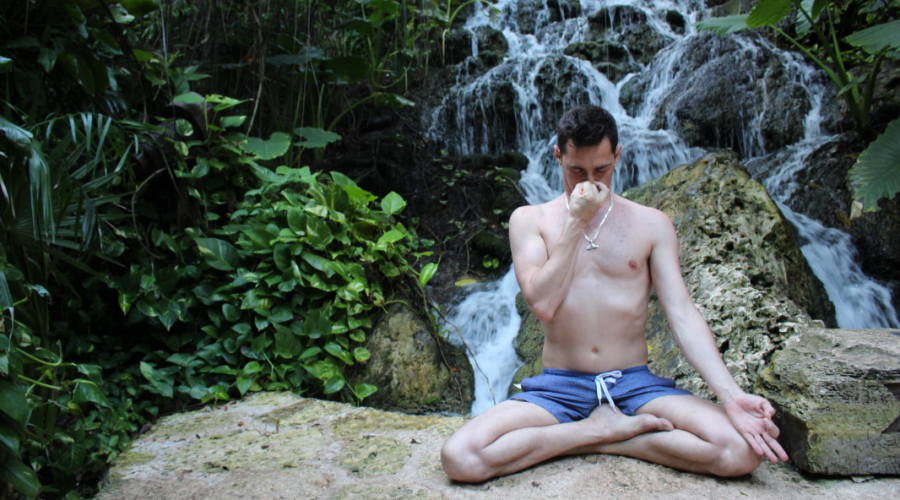
Javier Muriel, Pranayama 1aa
  • Understanding how breathing affects the body, mind and energy.

  • Regulate the nervous system to promote balance and wellbeing.

  • To master pranayama techniques with confidence, precision and depth.

  • To explore subtle anatomy through a practical, experiential approach.

  • To integrate a transformative practice into everyday and professional life.

Online Course

At your own pace · Online Campus · Unlimited access

  • PDF textbooks by subject.
  • Theoretical video lessons.
  • Guided practical sessions.
  • Multiple-choice tests.
  • Personalised practical activity sheet as a cross-curricular tool.
Screenshot taken on 12 February 2026 at 12:11:14

WOULD YOU LIKE PERSONALISED SUPPORT?

If you’re looking for a personalised and direct approach with the trainer, you can book one-to-one sessions which will allow you to

  • Live Q&A

  • Support with study, organisation and integration

  • Private consultations on real-life cases

Who is this training course for?

This course is for you if:

This course is for you if:

  • You practise yoga and want to gain a truly in-depth understanding of pranayama.
  • You’re a yoga teacher and feel you need a solid foundation before teaching breathing techniques.
  • You’re interested in breathing as a tool for inner transformation, not just as another technique.
  • You are looking to integrate classical pranayama with a contemporary understanding of the nervous system.
  • You want to practise kumbhaka gradually and safely, not by imitation.
  • You value clarity, sound reasoning and first-hand experience over the accumulation of techniques
  • You feel that your breathing needs to be in harmony with the rhythms of nature.
  • You are looking for a structured, progressive training programme with support throughout the process.
  • You have a background in body-based therapy and would like to broaden your perspective to include breathing and energy work.
  • You wish to establish yourself as a professional with the expertise to teach pranayama.

Who is this course not suitable for?

This course is not for you if:

This course is not for you if:
  • You’re looking for a quick course on techniques without having to go through a process of understanding first.
  • You expect immediate results without putting in the time for consistent practice.
  • You would rather just keep doing breathing exercises without understanding why you're doing them.
  • You’re not interested in studying the physiology or the nervous system that underpin breathing.
  • You are looking for a purely therapeutic approach without any personal element.
  • You are not willing to observe your own breathing and nervous patterns.
  • You want training that focuses solely on advanced techniques, without covering the basics.
  • You’re not looking to commit to a gradual learning process lasting several months.
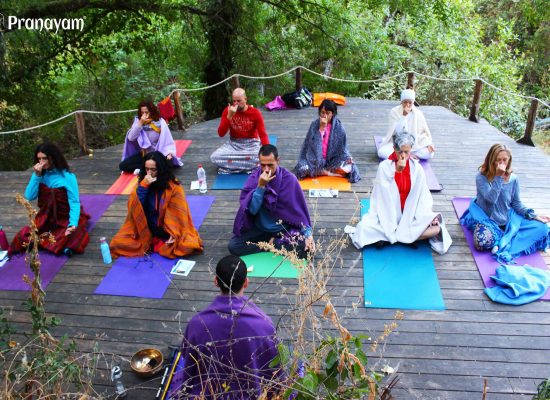
pranayam-casa-venera

What will I get when I finish?

It incorporates skills that enable you to practise Yin Yoga in a deep and coherent way

PRACTICAL RESULTS

• To design pranayama practices tailored to one’s constitution, stage of life and state of the nervous system.
• Practise kumbhaka gradually and safely, within your own window of tolerance.
• Integrate bandhas, mudras and pranayamas into a coherent sequence.
• Bring the practice into nature and in tune with the rhythm of the day.

PROFESSIONAL ACHIEVEMENTS

• To teach pranayama with discernment, sound principles and confidence.
• Design personalised breathing and regulation programmes.
• Position yourself as a leading figure in integrated pranayama within the Holistic EcoYoga framework.
• Opportunity to be listed in the Holistic EcoYoga Directory of Teachers and Centres.

PERSONAL RESULTS

• A structured and sustainable personal sadhana.
• The nervous system’s ability to self-regulate through breathing.
• An experiential understanding of subtle anatomy and prāṇa as a direct experience.
• Genuine integration of breathing into everyday life and the natural environment.
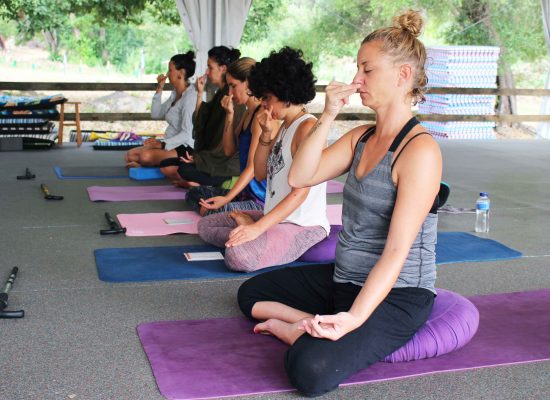
pranayama1

INVESTMENT IN TRAINING

REGULAR PRICE €750

CURRENT OFFER: 375 €

50% OFF for the first 5 registrations

One-off payment or instalments. See the FAQs for terms and conditions

Certification

Vocational training

Vocational training

The certification offered by this course is:

• Diploma valid for registration with Yoga Alliance as a YACEP (Yoga Alliance Continuing Education Provider).
• Can be combined with another 100-hour HEY course to qualify for 200 hours, or with two further HEY courses to reach 300 hours and register as an RYT200 or RYT500 with Yoga Alliance.
• Hours recognised towards the official vocational qualification in Spain.
• You can register with the Holistic EcoYoga directory.
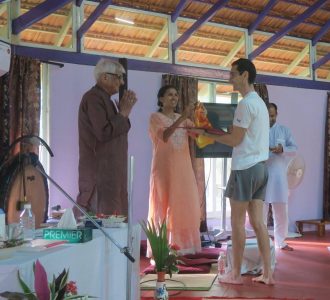
Trainer

This course is led by Javier Muriel, creator of the Pranayam® method


  • Yoga practitioner since 2005

  • E-RYT500 and YACEP teacher

  • Teacher with an official vocational qualification

  • Trained in pranayama and competitive freediving

  • Creator of the Pranayam® Method – Since 2014

  • Trainer with CFF

  • Find out more at: www.javiermuriel.net

This course does not merely explore Pranayama techniques in depth.
It offers you a holistic understanding of the breath as a bridge between body, mind, energy, awareness and nature.

Frequently Asked Questions

Find the answers to your questions below or email us at info@yogakula.es


Assessment system

The assessment system consists of three parts: 1) a test for each theory lesson on the Online Campus, 2) self-reflections for each module, and 3) a final project involving the design and justification of a 6-month personal sadhana. On the first day, the assessment process will be explained in detail and an informative PDF will be provided.

Attendance at live events

Attendance at the eight live sessions (Fridays from 9.30 am to 11.30 am) is not compulsory, although it is strongly recommended. All sessions are recorded on the campus and can be watched at a later date.

Online Course

The online course can be taken:

  • At your own pace: to obtain the 100-hour diploma, you must complete the multiple-choice assessments, submit your self-reflections and the final project.
  • At your own pace + group support: you can work through the theoretical and practical content at your own pace, whilst also having the option of feeling supported by a group and taking part in live sessions on specific dates.
  • At your own pace + one-to-one support: you can book occasional one-to-one sessions with Javier to ask questions or present your final project.

Prerequisites

There are no formal requirements, although it is advisable to have a well-established yoga practice and some familiarity with mindful breathing. Block I starts from scratch with physiology and the nervous system, so no prior scientific training is required.

Career paths and opportunities

This course can be taken simply to learn more for your own personal practice. If you are also a yoga professional, or aspire to become one, it will provide you with the knowledge and tools to teach pranayama in group classes, workshops and personalised breathing and regulation programmes.

Payment options

When you register via the payment gateway on the website www.holisticanature.com You’ll be able to choose from a range of payment methods:

1. Transfer. Once you have selected this option, you will find the bank details for making the one-off payment

2. I’ll pay via PayPal. With this option, you can choose between a one-off payment or payment in three instalments, interest-free

3. Payment by Card. In this case, you can only choose the one-off payment option

4. Payment via Sequra. With Sequra, you can pay for the course in 3, 6, 9 or 12 monthly instalments, with interest rates depending on the number of months.
Limited places available

We work with small groups to provide a better service. If you feel the call, don’t think twice: places fill up quickly. Remember that the first five places are eligible for the special 50% offer.

Support and guidance

We’re here to help you. We greatly value connecting with our students through live sessions and encourage self-reflection so that we can share experiences, opinions and ways of life as a group. We provide personalised support for your practice without being patronising, empowering you so that by the end you feel confident enough to share at whatever level you wish.

Will I be able to teach once I’ve finished?

Yes. This training course is designed to equip you with the knowledge and skills needed to lead both group and personalised pranayama classes and workshops, tailored to each practitioner’s constitution, stage of life and state of the nervous system.

Screenshot taken on 12 February 2026 at 12.16.32

DO YOU HAVE ANY QUESTIONS?

WRITE TO US AT

info@yogakula.es